
Last updated 18 November 2026.
These guides answer the questions in the order in which they arise: where to start, which protocol, which system, and what to do if you rent. The full beginner map is the complete guide to beginning a smart home.
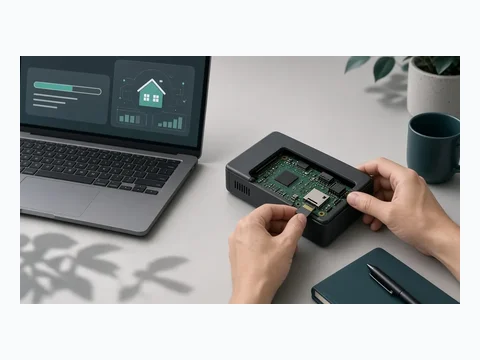
Home Assistant Green — a ready-made local hub. Pair it with a Zigbee dongle (Amazon.ca, sponsored link).
The essentials at a glance {#essentials}
| Guide | The question it answers | Our short answer |
|---|---|---|
| Complete beginner guide | the ordered path: hub, devices, automations, FAQ | a local Home Assistant plus Zigbee kit for most beginners |
| Smart home for beginners: where to start | the short UK and US first-equipment path | a Home Assistant box and some Zigbee sensors |
| Zigbee, Wi-Fi, Z-Wave, Thread or Matter | which protocol to choose | Zigbee for sensors, local Wi-Fi for plugs and cameras |
| Home Assistant, Jeedom, Homey or an off-the-shelf box | what to use as the brain of the home | Home Assistant, free and local |
| Smart home for renters, no drilling | what you can install without drilling | plugs, battery sensors, wireless buttons, thermostatic heads |
Our best choice to get started {#best-choice}
Home Assistant on a Home Assistant Green or a Raspberry Pi 5, with a Zigbee dongle. This is the base we use in all our tutorials: everything stays local, without a subscription, and the system grows with your needs.
And then? {#next-steps}
- Install the server: Home Assistant on a Raspberry Pi 5, from the Home Assistant section.
- Buy the first devices: the buying guides section.
- Make your own sensors: the ESP32 projects section.