Home Assistant Green vs Raspberry Pi 5: which to choose (2026)
Home Assistant Green or a Raspberry Pi 5 for your smart home hub? Official specs side by side, what's in the box, what you must add, and who each one suits.

Getting started
Home Assistant
Buying
Home Assistant Green or a Raspberry Pi 5 for your smart home hub? Official specs side by side, what's in the box, what you must add, and who each one suits.
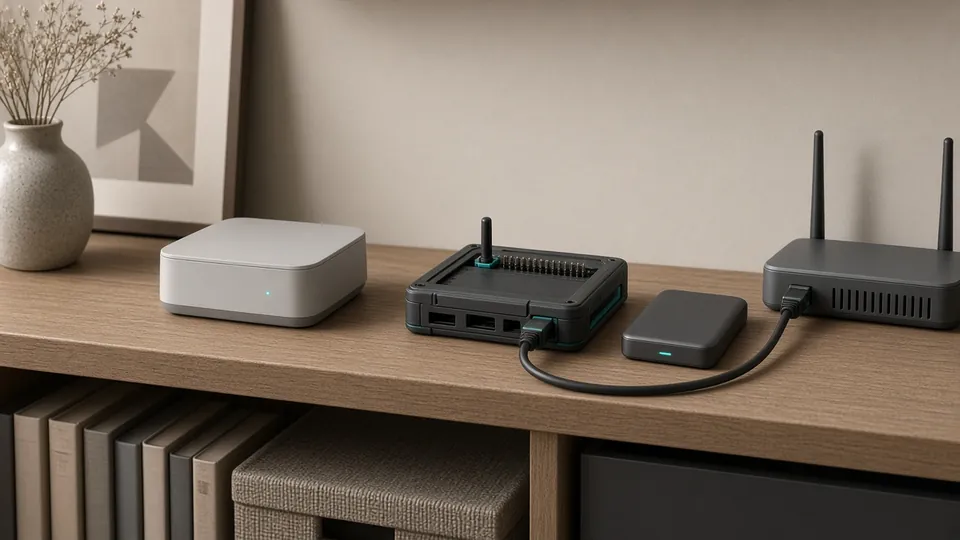
AI-generated illustration
Both run Home Assistant OS and both make an excellent local smart home hub. The difference is set-up time versus flexibility. Specs below come from the official pages: Home Assistant Green and Raspberry Pi 5 (checked 21 October 2026). We have not benchmarked them ourselves.
| Home Assistant Green | Raspberry Pi 5 (4GB or 8GB) | |
|---|---|---|
| In the box | finished device: case, storage, power supply | Raspberry Pi 5 (4GB or 8GB)">bare board only |
| Processor | quad-core Cortex-A55, 1.8 GHz | Raspberry Pi 5 (4GB or 8GB)">quad-core Cortex-A76, 2.4 GHz |
| RAM | 4 GB LPDDR4X | Raspberry Pi 5 (4GB or 8GB)">4 or 8 GB LPDDR4X (also 1, 2 and 16 GB) |
| Storage | 32 GB eMMC, built in | Raspberry Pi 5 (4GB or 8GB)">microSD, or NVMe SSD via a PCIe add-on |
| USB | 2 × USB 2.0 | Raspberry Pi 5 (4GB or 8GB)">2 × USB 3.0 + 2 × USB 2.0 |
| Ethernet | Gigabit | Raspberry Pi 5 (4GB or 8GB)">Gigabit |
| Wi-Fi | none (Ethernet only) | Raspberry Pi 5 (4GB or 8GB)">built in (Ethernet still recommended for a hub) |
| Power supply | universal supply included | Raspberry Pi 5 (4GB or 8GB)">buy the official 27W USB-C supply (UK, US and EU plugs available) |
| Cooling | fanless | Raspberry Pi 5 (4GB or 8GB)">Active Cooler recommended |
| Set-up | plug in Ethernet and power, open homeassistant.local:8123 | Raspberry Pi 5 (4GB or 8GB)">flash Home Assistant OS with Raspberry Pi Imager, then boot |
| Price | Home Assistant Green, official page. This English page does not copy a US or UK price. | Raspberry Pi 5 (4GB or 8GB)">Raspberry Pi 5, official page. The board still needs a power supply, a case and storage. |
Not sure which Pi 5 memory size? Read Raspberry Pi 5: which RAM to buy.
Neither device has Zigbee built in. Plug in a USB coordinator on a short extension cable to reduce interference: see the best Zigbee dongle for Home Assistant.
Verdict: Green for zero-hassle; Pi 5 for power and flexibility.
Was this page helpful?
Thank you!
What should we improve?
Torn between two models or stuck on a build? Drop us a line and we will get back to you by email.
Cookies and analytics
We use Google Analytics 4 to understand how the site is used (page views, navigation). It is only switched on if you accept. Declining does not stop you using the site. More: cookie settings and privacy policy (in French).